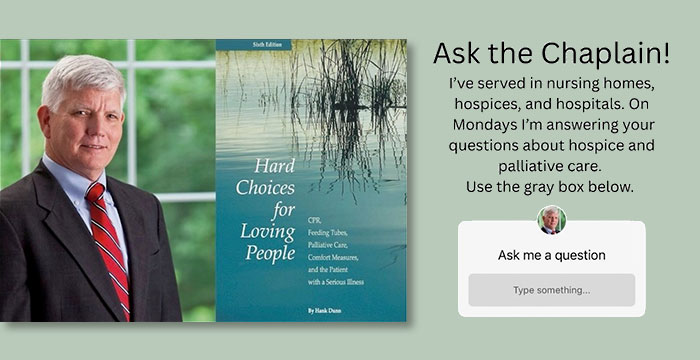

Last September, I started posting a Q&A box in my Instagram stories (@hospicechaplainhank), prompting people to ask questions about hospice and palliative care, called “Ask the Chaplain.” I am holding off on answering new questions to review previous questions and answers in this blog. Two of the latest questions are below:
What do you say when someone asks, “Why is this happening to me?”
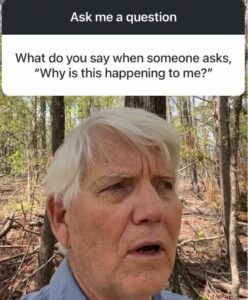 Spoiler alert — the only answer is “Why not me?”
Almost all my clinical experience has been with nursing home and hospice patients. By the time patients end up there, they most likely have already worked through this question, having lived with a serious illness for months, if not years. Even younger patients (in their 40s, 50s, or younger) usually address this question during the earlier stages of their illness.
For the rare nursing home or hospice patients who still ask the question, I turn it back to them. “Why do you think this is happening to you?” For a chaplain, that is what is important: to find out where the patient is. Are they feeling God is punishing them? Then, we explore that and talk about forgiveness. Are they grieving the loss of a future life on this earth? Then, we explore that grief.
Most people are aware that death comes to all sooner or later. They may be sad that their time has come but accept it as they have seen so many before them. Most conclude that the answer to the “Why me?” question is, “Shit happens.”
I had a patient one time who had a disease so rare that there were only 7 known cases. I asked him how he felt about having such a rare disease. He smiled and said, “Special.” He died on Christmas Day.
How do families and patients experience hope in hospice when a cure is no longer possible?
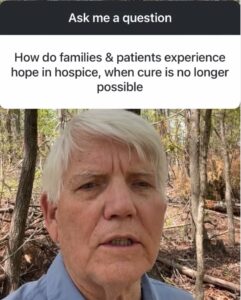 When most people talk about hope in the context of being a hospice patient, they usually talk about hope that the patient won’t die. Families sometimes want to hide the prognosis from a patient because they don’t want them to “give up hope,” meaning give up life and die.
Many patients have the spiritual conviction that they will live beyond the grave. Christians call it “The blessed hope.” For them, this is the ultimate form of hope.
I like to help patients and families explore hope further by asking, “Are there other things to hope for than NOT DYING?” Can we hope that the pain can be controlled and symptoms managed? Or can we hope that the family will be supported while the patient is dying? Can we hope that the family will be okay — sad, of course, but will go on after the patient dies?
It is in these discussions that some patients can experience hope in many other ways.
__________________
Author Chaplain Hank Dunn, MDiv, has sold over 4 million copies of his books Hard Choices for Loving People and Light in the Shadows (also available on Amazon).