
Compassionate, informed advice about healthcare decision making

Posts Tagged ‘good death’

The Patient Wanted “Peace” — His Wife Wanted “Cure” — What Is a Good Death?

Posted by

“I pray for peace,” said the man with advanced cancer. He was a new in-home hospice patient I was visiting for the first time. Turns out, I knew his wife as a coworker at the nursing home from years before — she was a nurse, and I was the chaplain.

We were sitting in the upstairs bedroom of their suburban home. He was in a wheelchair, and I was sitting in front of him. His wife was in a chair on the other side of the room. I often ask patients, “Do you pray?” And like most everyone else, this man replied, “Yes.”

“What do you pray for?” was, of course, my next question. “I pray for peace,” he immediately responded. Across the room, out of sight of my patient, his wife was shaking her head, as if to say, “That’s not what I pray for.”

As we walked down the stairs on my way out, she confided, “I pray for a cure.” That was totally understandable.

This scene came to mind as I listened to a recent GeriPal Podcast titled, “What Makes a Good Death?” I have also explored this topic in a previous blog, “Can a POW Have a Good Death Hundreds of Miles from Home.”

Peace is more important to patients than doctors imagine

Photo by Raphael Nogueira on Unsplash

The “GeriPal” podcast focuses on geriatrics and palliative care. Each week, they feature the latest research on a variety of topics. Last week, they were revisiting the idea of a good death from the perspectives of patients, families, doctors, and other healthcare professionals. They also discussed a new paper comparing and contrasting the idea of a good death as found in Brazil versus the United Kingdom.

One of the surprises in the research is that although patients felt being at peace was important, physicians did not believe that it was that important for a “good death.” Another curious finding was that doctors rated being pain-free higher than patients did. Perhaps that was related to the finding that patients rated being mentally aware as more important and doctors not so much.

Control in Brazil v. the UK

Photo by Marcin Nowak on Unsplash

Another interesting finding was the idea of being in control of the dying process. Folks in the United Kingdom ranked being in control as very important. Responses from Brazil were essentially, “What do you mean by ‘control?’ God is in control.” This, of course, reflects the more religious leanings in Brazil compared to the more secular UK.

The bottom line — listen to patients

Researchers concluded by warning all of us not to make assumptions about a particular patient or their family. Yes, there are often common ideas about what constitutes a “good death.” But this particular patient might not agree. So, we need to stay curious — and ask.

The whole podcast episode is worth a listen or, at least, read the transcript.

__________________

Author Chaplain Hank Dunn, MDiv, has sold over 4 million copies of his books Hard Choices for Loving People and Light in the Shadows (also available on Amazon).

Follow Hank: LinkedIn | Instagram | Facebook | YouTube

Having a “Happy Death” — How weird is THAT?

Posted by

Recently, Roman Catholic Pope Francis referred to Saint Joseph as the “patron of a happy death.” Here’s the problem: I usually associate happiness with smiles, laughter, and a sense of the lightness of life. “Happy” and “death” are hard for me to connect.

The Pope stood before a General Audience and introduced the phrase “happy death” in the first words he spoke about Joseph (you know, Joseph, the husband of Mary and earthly father of Jesus). He never again used the word “happy” in his brief remarks.

What is it about the word “happy”? Why is it so hard to associate it with death and dying?

I want to drop off a “happy”

Three years ago, we moved to the Deep South in the hill country of Oxford, Mississippi. Here we might get a call from a friend, “Y’all going to be home? I want to drop off a happy.” That means she’s going to bring over a gift. It might be fresh-made pimento cheese or a potted plant. Let me tell you — in Oxford, if you tell someone you are feeling sick, you will get more hospitality than you can imagine. People will be dropping off happys all day.

Then, of course, “happy” is enshrined in the Declaration of Independence with the words, “inalienable rights of life, liberty and the pursuit of happiness.” An earlier draft had the words “pursuit of property.” Even today, many people assume accumulating worldly treasures and wealth will make you happy. From surveys, we find out the very wealthy are not any happier than those of more modest means. Once you move out of poverty into a stable financial situation, you are as happy as you will get.

Jesus and Mary as the “hospice team”

So how did Pope Francis associate Joseph with a happy death? As far as we know, he died while Jesus still lived at home before starting his ministry. The assumption is that the dying Joseph was cared for by Jesus and Mary. They were on his “hospice team,” so to speak. I guess you could also assume you’d have a happy death having Jesus and Mary as your caregivers.

Then Pope Francis goes on to discourage prolonging dying with overtreatment. He encourages relieving suffering with pain medications and mentions palliative care. These are elements of what we today call a “good death.”

Maybe not a “happy” death but a “good” death

Recently, I wrote a blog and shot a brief video where I explored the components of a good death in the 19thcentury. For obvious reasons, the elements of a good death in first-century Palestine, on an American Civil War battlefield, and today in a hospital have changed. We may have more tools now to control pain, but at the same time, dying can be unnecessarily prolonged by being hooked up to machines.

It doesn’t matter whether you call it “happy death” or “good death.” The hope is that we can have the best death we could imagine. Most likely, that will involve having family gathered around, being free of pain, and in a place of our choosing.

_________________________________________

Chaplain Hank Dunn is the author of Hard Choices for Loving People: CPR, Feeding Tubes, Palliative Care, Comfort Measures and the Patient with a Serious Illness and Light in the Shadows. Together they have sold over 4 million copies. You can purchase his books at hankdunn.com or on Amazon.

Can a POW have a “Good Death” Hundreds of Miles from Home?

Posted by

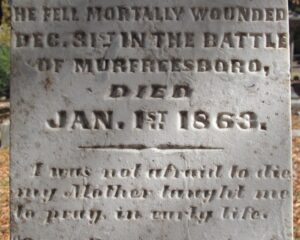
A young soldier named William Gaston Barringer turned 18 on October 5, 1862. Less than three months later, he was wounded and died as a prisoner of war 200 miles from home. Yet, there is evidence he had a good death. How could this be?

Barringer’s marker caught my eye as I wandered around St. Peter’s Cemetery in Oxford, Mississippi. The epitaph, “I was not afraid to die; my Mother taught me to pray in early life,” got me thinking about what it means to have a good death. (See my “Hank’s Deep Thoughts” video at the monument.)

Let me clarify; a “good death” does not mean that it was good that William died. Death to the young is, of course, a tragedy. And, as a POW, he likely did not die in ideal conditions.

Being a prisoner of war was not mentioned on the monument. I did an internet search and found him on a list of soldiers who died in captivity, hundreds of miles away in Murfreesboro, Tennessee.

A “good death” through the centuries

Plagues in the 1300s killed 40-60% of the European population. Such widespread death led to the release of a couple of books known as the Ars moriendi (“The Art of Dying”). These were Christian instructions on how to have a good death. There were accompanying woodcuts, like one showing demons tempting the dying man with crowns symbolizing earthly pride.
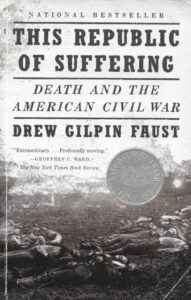
 

By the American Civil War (1861-65), the dying and their families knew what was expected. Drew Gilpin Faust identified four elements of a good death in her moving book, This Republic of Suffering: Death and The American Civil War. According to Faust, a good death in the 19th century was one where the dying person:

  1. Was conscious
  2. Was not afraid of dying
  3. Was prepared spiritually to meet their maker
  4. Left dying words for the family


Even the atheist Charles Darwin, who died in 1882 in England, kept to this script. He told his wife on his deathbed, “I am not the least afraid of death—Remember what a good wife you have been to me—Tell all my children to remember how good they have been to me.”

Though a reference to spiritual things was conspicuously absent, Darwin was conscious, was not afraid of dying, and left last words for his family. In my interpretation, he wanted to emphasize that even though he had no spiritual leanings, he was still “not the least afraid of death.”

Much has changed since the Civil War, including our expectations about our deaths. Today, medical literaturedescribes what many now consider a good death: being in control, being comfortable and free of pain, having a sense of closure, etc.

This sense of control has recently manifested itself through eleven U.S. jurisdictions adopting medical aid in dying. In those places, patients can ask a physician to give them medication to hasten their dying.

Back to Mr. Barringer

The words on Barringer’s marker were an assurance to his family that he died a good death: “I was not afraid to die; my Mother taught me to pray in early life.” These seem like the dying words of a conscious man.

And there it is. William was conscious, he was not afraid of dying, he was prepared spiritually (thanks to his mother), and these are the words he left for others. I can imagine his mother visiting this monument often in her grief and being consoled, “At least he had a good death.”


__________________________________________

Chaplain Hank Dunn is the author of Hard Choices for Loving People: CPR, Feeding Tubes, Palliative Care, Comfort Measures and the Patient with a Serious Illness and Light in the Shadows. Together they have sold over 4 million copies. You can purchase his books at hankdunn.com or on Amazon.

Quality of Life Publishing Logo

Quality of Life Publishing Co. is the proud publisher of Hank’s books, as well as other branded educational materials for health care & end-of-life care.

www.QOLpublishing.com

Copyright 2025, Hank Dunn. All rights reserved. Website design by Brian Joseph Studios

Volume Discounts for Branded Book Orders

Minimum quantity for branded books is 100. English and Spanish branded books are sold separately. Click here for more information or contact us with questions.

Black

  • 100 to 249 copies: $4.50 each
  • 250 to 499 copies: $3.50 each
  • 500 to 999 copies: $3.00 each
  • 1000 to 1499 copies: $2.25 each
  • 1500 to 1999 copies: $1.75 each
  • 2000 to 3999 copies: $1.60 each
  • 4000+ copies: $1.45 each

Color

  • 100 to 249 copies: $7.00 each
  • 250 to 499 copies: $4.50 each
  • 500 to 999 copies: $3.50 each
  • 1000 to 1499 copies: $2.50 each
  • 1500 to 1999 copies: $2.00 each
  • 2000 to 3999 copies: $1.85 each
  • 4000+ copies: $1.70 each


Volume Discounts for Unbranded Book Orders

Each title/language sold separately.

  • 1 to 9 copies: $8.00 each
  • 10 to 24 copies: $5.75 each
  • 25 to 49 copies: $4.50 each
  • 50 to 99 copies: $4.00 each
  • 100 to 249 copies: $3.50 each
  • 250 to 499 copies: $3.00 each
  • 500 to 999 copies: $2.50 each
  • 1000 to 1499 copies: $2.00 each
  • 1500 to 1999 copies: $1.50 each
  • 2000 to 3999 copies: $1.35 each
  • 4000+ copies: $1.20 each