

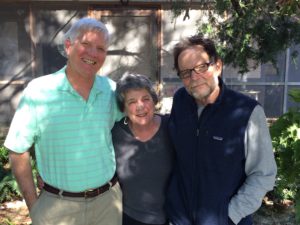
Hank and his sister Janice with their brother Dennis two weeks before he died
My birthday passed last week. Number 74. Now, a bitter-sweet day.
Bitter-sweet because I miss my younger brother, Dennis. He died on my birthday five years ago. When his wife called my sister to tell her Dennis had died, she said, “Don’t tell Hank. It will ruin his birthday.” She was right. My sister immediately called me, and it ruined my birthday.
The day now brings the appropriate mix of gratitude for another year of life and grief that my brother is no longer here to call me with birthday wishes. Bitter-sweet.
I find I’m getting more curious about myself as I settle into over seven decades above ground. What am I curious about? About me. My thinking. My spiritual beliefs. I’m curious how can I still find new ways of thinking about and experiencing things spiritual. Curious how I find new ways of verbalizing these experiences.
An old man listening to books
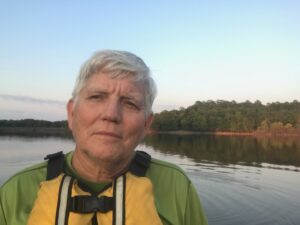
Hank’s 74-year-old self
Last week, I told the story of an old man at the nursing home where I was the chaplain. I was in my 30s and he was in his 90s. The story was about his loveless marriage (according to his wife), but I mentioned that he listened to recorded books.
Every day, he’d be bent over in his wheelchair, leaning down, straining to hear history books being read on a record player. As a young man, I thought, “What is he doing? What is this 90-year-old man going to do with this new knowledge?” He talked very little. He was years past teaching children, or anyone for that matter. He just sat in his room and listened as the day crept slowly by. Now, I think, “I am the old man!”
You start dying slowly
Late last year I was introduced to the poem “You Start Dying Slowly” by Martha Medeiros. In Portuguese it is A Morte Devagar — “A slow death”. This poem meant so much to me that I printed it out and glued it to the inside of the journal I just started in November.
Here are a few lines:
You start dying slowly…
If you do not risk what is safe for the uncertain,
If you do not go after a dream,
If you do not allow yourself,
At least once in your lifetime,
To run away from sensible advice…
Referring to the poem, I wrote in the journal on November 21, 2021, “I am profoundly moved by this piece. I still marvel that, at my age, I am still wanting to make something of my life. I still struggle with taking risks.” Weeks later, on January 4th I wrote, “‘Who are you God and who am I?’ St. Francis said and I BOTH say. I am almost 74 and have not settled this.”
My 24-year-old self meets my 74-year-old self — it is not pretty
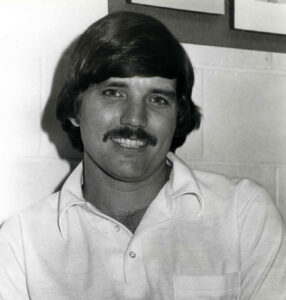
Hank’s 24-year-old self
Fifty years ago, if my 24-year-old self met my now 74-year-old self, he would have called me a heretic. I was so certain about things at 24. Now, being “right” is less important. Rather, following the teaching of Jesus, right action is more important that right theology.
Now, questions are more important than answers. Curiosity feels better than certainty. I am the old man listening to books. I listen not to know more but to be comfortable with not knowing. The mystics are my favorite guides. Thomas Merton summed up, for me, the mystery of knowing and not knowing God:

Thomas Merton
“Your brightness is my darkness. I know nothing of You and, by myself, I cannot even imagine how to go about knowing You. If I imagine You, I am mistaken. If I understand You, I am deluded. If I am conscious and certain I know You, I am crazy. The darkness is enough.”
__________________________________________
Chaplain Hank Dunn is the author of Hard Choices for Loving People: CPR, Feeding Tubes, Palliative Care, Comfort Measures and the Patient with a Serious Illness and Light in the Shadows. Together they have sold over 4 million copies. You can purchase his books at hankdunn.com or on Amazon.
 Nowadays people handle loveless marriages differently. My friend’s husband left her for another woman after 30 years of marriage. A couple of months after he moved out, he told my friend, “I feel for her what I always wanted to feel for you.” She thinks he never loved her.
 Which is the better way? Staying in a loveless marriage or leaving it to find your true love? Or is there a third way? Falling in love with your spouse. It would have taken work and probably therapy. There must have been some small spark of love at the start. Perhaps that was an ember that could have been rekindled.
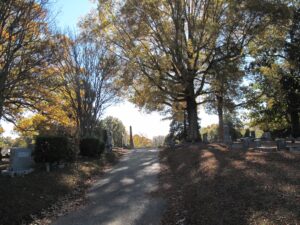 A young soldier named William Gaston Barringer turned 18 on October 5, 1862. Less than three months later, he was wounded and died as a prisoner of war 200 miles from home. Yet, there is evidence he had a good death. How could this be?
 Plagues in the 1300s killed 40-60% of the European population. Such widespread death led to the release of a couple of books known as the Ars moriendi (“The Art of Dying”). These were Christian instructions on how to have a good death. There were accompanying woodcuts, like one showing demons tempting the dying man with crowns symbolizing earthly pride.
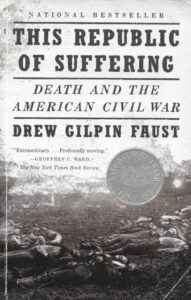 Was conscious
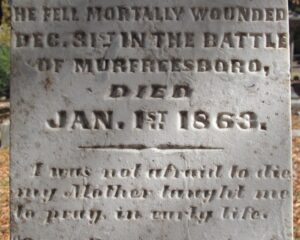 The words on Barringer’s marker were an assurance to his family that he died a good death: “I was not afraid to die; my Mother taught me to pray in early life.” These seem like the dying words of a conscious man.
 “I know he would never want to be kept alive like this,” she said to me over the sound of a machine forcing air into her husband’s lungs. He lay motionless, eyes closed. He had been like this for months after arriving at the nursing home from the hospital.
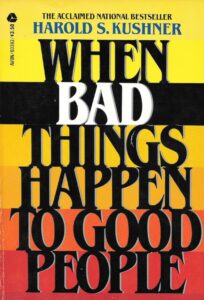 Since she was Jewish and asked this question, I gave her a copy of Rabbi Harold Kushner’s